
Beware this green menace!

An Io moth full-grown larva. Photos by Donald W. Hall, University of Florida
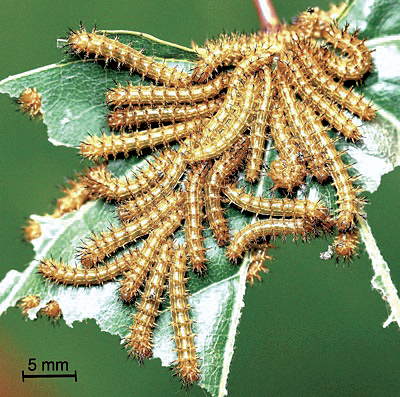
Io moth larvae. Photos by Donald W. Hall, University of Florida
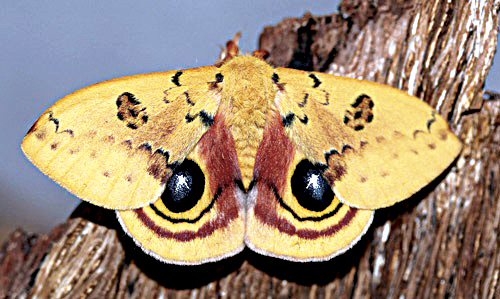
A male Io moth, Automeris io (Fabricius). Photos by Donald W. Hall, University of Florida
An Io moth full-grown larva. Photos by Donald W. Hall, University of Florida
Io moth larvae. Photos by Donald W. Hall, University of Florida
A male Io moth, Automeris io (Fabricius). Photos by Donald W. Hall, University of Florida
Trending
Shortly after I moved to Southwest Florida, I was walking in my garden and noticed that several branches on a standard hibiscus had been defoliated overnight. I walked over to the shrub and unwittingly began inspecting the branches when I received a vicious sting. At first, I thought I had encountered a wasp, but upon closer examination I observed a large bright green caterpillar. I would soon learn that the caterpillar did indeed sting me, and that it was a true green menace!
The caterpillar in question was an Io moth caterpillar, one of seven species of Automeris moths, with a geographic range from Canada west to Utah and south to Costa Rica and Mexico. The caterpillar can reach lengths of 2.5 inches and is bright green with a yellow-white and red stripe; its body is covered in tufts of black-tipped yellow-green spines. These spines are hollow and break off easily, embedding deeply into skin. When the spines break off, they release a substance known as urticating venom, which causes a sudden burning or stinging sensation. The affected area may redden and begin to itch and turn red; some individuals experience allergic reactions which require medical attention.
I had quite a reaction to the sting with raised red itchy welts that lasted for several days. If you have the misfortune to be stung by one of these caterpillars, immediately cover the area with cellophane tape, which when removed will extract the tiny spines. Wash the area carefully and apply ice and a baking soda and water paste to help relieve pain; you should also observe the area for any signs of a serious reaction.
If you have observed Io moth caterpillars in your gardens, please be sure to warn young children as they are often attracted to these colorful caterpillars.
Unfortunately for us, the Io moth caterpillar is present year-round in our warm climate and some of its favorite food is available in abundance. The caterpillars feed on a wide variety of plants including hibiscus, royal poinciana, Washington fan palms, red mangroves, elms and willows. The female moth lays small clusters of 20-35 creamy white eggs along the stems and ribs of the leaves on host plants. During her brief life span, a female will lay several hundred eggs; adult Io Moths do not have functional mouthparts and cannot eat, so their lifetime is only one to two weeks. Around 10 days after being deposited, tiny 2 to 3 mm larvae emerge and begin to gorge themselves on the host plant. The caterpillars develop through 5 instars, or phases, between two periods of molting, and each instar possesses urticating spines. The first instars are yellow to orange or brown in color and are present in groups; these early instars are usually present on the underside of leaves and can be difficult to observe. The final instar is the familiar lime green caterpillar which is solitary; after 4 weeks the mature larva spins a loose silken cocoon among debris on the ground or in crevices. The adult moths emerge in several weeks and are primarily active at night; given their short lifespan they breed almost immediately after leaving the cocoon.
What are the signs that you have an Io moth caterpillar problem? The caterpillars can defoliate a shrub almost overnight, and this is generally your first indication that you have an issue. Another clue is the presence of “frass” or excrement; all that voracious eating produces an abundance of small dark pellets! The caterpillars are often difficult to see as they are the same color as new leaf growth, and the initial instars are quite small and cluster together on the underside of leaves. One thing is certain - if you see one Io moth caterpillar there are more in the area!
If you see signs of an infestation, make sure you wear gloves and very carefully search for the caterpillars. The best way to deal with these pests is to knock them to the ground and step on them or cut them in half with pruners as I do - just be careful not to touch them. Pesticides are not recommended as they are not effective for 1-2 days and the caterpillars can do a lot of damage in that span; pesticides also negatively impact other beneficial insects and butterflies.
I hope that you never encounter an Io moth caterpillar in your yard - but if you do, you now have a good idea of what to expect and how to deal with this green menace. Fortunately, I haven't seen any Io Moth Caterpillars in my gardens for the past 18 months, and I sure hope that continues!
—
Please plan to join us at the Tropical Plant Bazaar at Rotary Park on Saturday, Oct. 23, from 9 a.m. to 2 p.m. The Garden Club of Cape Coral will be offering a wide variety of plants for sale, and there will also be an assortment of vendors participating in the event.
Cathy Dunn is a Lee County Master Gardener Volunteer and Garden Club of Cape Coral Member.