
An introduction to the vanilla orchid
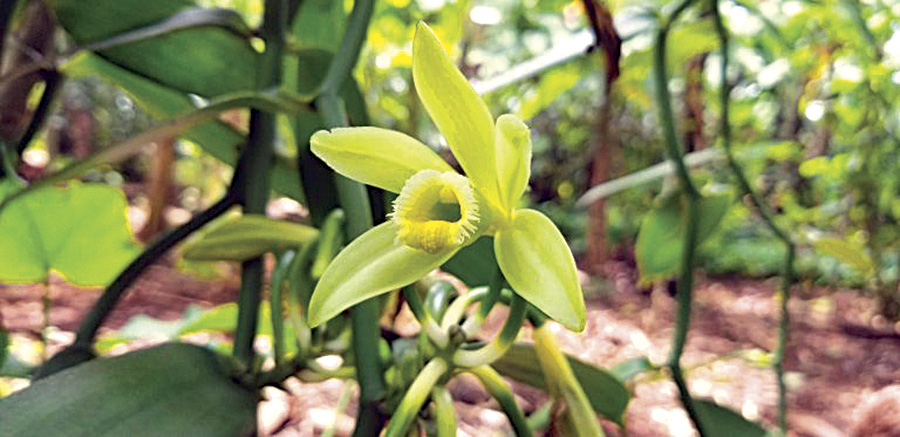
Vanilla planifolia in bloom. PHOTO PROVIDED by UF/IFAS

Vanilla planifolia in bloom. PHOTO PROVIDED by UF/IFAS
Trending
When something is described as “vanilla” it is usually meant to denote a plain item without a lot of pizzazz. That descriptor, however, is very misleading! The vanilla orchid, or Vanilla planifolia, is the plant that provides natural vanilla flavor, and the vanilla bean is the only edible fruit in the orchid family.
This exotic plant produces the world's most popular flavor, with demand increasing every year for natural vanilla. Vanilla is not only popular, but also quite valuable; only saffron is more expensive. As consumers demand natural vanilla over vanillin, the synthetic version of vanilla, many food companies are moving to reduce the use of vanillin in their products.
And vanilla extract has uses beyond the food industry; it is used medically as a natural anti-microbial remedy and is being evaluated as a treatment for sickle cell anemia. Perfumers also use vanilla to impart a sweet fragrance to their signature scents.
The vanilla orchid is native to Mexico, and the Spanish explorer Hernan Cortes first took vanilla plants to Europe in 1519. Without a suitable tropical climate and bees to pollinate the flowers, vanilla orchids could not be cultivated successfully in Europe for almost 300 years. Once greenhouses became available to support the plants and manual pollination techniques were developed, it was finally possible in the mid-19th century to propagate the plants in Europe.
While Europe struggled to produce vanilla orchids, the plants first spread from their native range to the Caribbean Islands and other tropical climates around the globe, particularly in European colonies in Africa and Asia. Since the early 1900s, vanilla orchids have been cultivated in Puerto Rico, Hawaii and Florida.
The vanilla industry grew in Puerto Rico throughout the 1950s but declined as the post-war economy favored industrial development over agriculture. Hawaii faced a similar decline in vanilla production, as tourism rapidly grew to be the state's major economic sector. Today Madagascar produces more than 80% of the world's vanilla, with Indonesia, Uganda, India and Mexico supplying most of the remaining product.
The U.S. is the largest importer of vanilla beans, with most of those beans processed as vanilla extract.
The vanilla orchid is a thick, fleshy perennial vine that lives for many years, and can reach lengths of over 200 feet. The orchid is considered “semi-epiphytic,” which means that the stem can be planted in soil forming terrestrial roots and can also grow on other plants as an epiphyte, or air plant, using aerial roots to support its climbing habit.
The flowers are large and fragrant, and depending on the variety, range in color from a creamy green to light green with purple accents. Flowers form in clusters 2-3 years after planting when the vines reach a thickness of .25 to .50 inches; usually a single flower will open early in the morning, but up to 3 flowers can bloom at once.
The bloom on the Vanilla planifolia lasts only one day, but blooms on other vanilla species may remain viable longer. Once the orchid begins to bloom, it will continue to flower for about 2 months. When the bloom is pollinated, it produces a “bean” or seed capsule that can reach 8 inches in length and takes between 8 to 9 months to ripen. This bean is then “cured” for 3-4 weeks in a 4-step process before shipping.
You can grow vanilla in your home garden by purchasing a potted plant or obtaining a cutting of Vanilla planifolia; a large cutting (24-36 inches in length) can root and flower in 2-3 years. Smaller cuttings will take longer, approximately 3-4 years. The vine should be planted at the base of a support structure such as a tree or trellis; vanilla orchids prefer good air flow and bright, indirect light.
When I recently planted a cutting, I used the same method of tying the vine to a tree with green plastic stretch tape that I use with other orchids; this will train the orchid to produce aerial roots that will secure it to the tree in several months. Vanilla orchids require little care - once they are established you won't need to water, prune or fertilize your plant!
Next month I will discuss the value of vanilla as an exotic crop, and the efforts underway here in South Florida by the University of Florida/IFAS Tropical Research and Education Center (TREC) to establish vanilla as a successful crop for commercial growers.
Cathy Dunn is a Lee County Master Gardener Volunteer Garden Club of Cape Coral member.