
More garden myths
Trending
Last month we explored some common garden myths that the University of Florida/Institute of Food and Agricultural Services (UF/IFAS) has identified as among the most common "tall tales" that they encounter through their extension services. These myths are generally inspired by a grain of truth and passed along among gardeners, sometimes becoming "established fact" promoting gardening practices that are not based on actual science.
By discussing some of these better-known myths, I hope that you will be prompted to think about some of the advice you've followed and to question the validity of the rationale behind the practice.
The myth that seems to be in the back of my mind as I garden is that snakes are aggressive. Even after years of education and exposure, I am still petrified of snakes and my first reaction upon encountering a snake in the garden is that it is out to get me. And I know better; one entire session of our Master Gardener training was on snakes and trust me, I really wanted to skip that particular class because we had live snakes in the room with us!
Science tells us that even snakes that are surprised are rarely aggressive, and they are an important contributor to the Florida ecology. But it's hard to remember that when you suddenly see a garter snake wriggling in your garden! You should, of course, exercise caution when you're working in areas that provide hiding places for snakes, and never approach any snake that you come across. That's never a problem for me because I'm usually running in the house either screeching or speechless!
UF/IFAS has lots of information online about snakes, and if you need assistance in identifying a snake, you should contact a professional; the Florida Fish and Wildlife Conservation Commission has a list of professionals you can consult on its website.
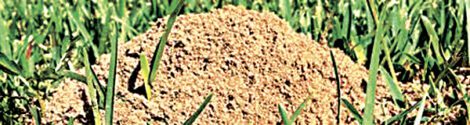
You may have heard one of many myths concerning fire ants and how to control them; stories circulate about using grits, soap, soda water, diesel fuel or citrus peels to deter these garden pests. Some of these methods may encourage fire ants to relocate, but they rarely move far from their original mounds. The unfortunate truth is that there is no known method to permanently eliminate fire ants from an area. UF/IFAS recommends using boiling water and employing garden-specific baits and contact pesticides only as needed. The best advice is to call your local extension service office for help; the Lee County office can be reached from 9 a.m. to 5 p.m., Monday through Friday, at 239-533-4327.
There are many myths about methods that can be used to deter moles. Vibrating devices that emit “mole repelling sonic vibrations” are touted as the perfect, non-toxic remedy for eliminating moles. UF/IFAS scientists have studied these devices and found that they are not effective, pointing out that mole tunnels located next to highways with vibrations from heavy traffic suggest that vibrations are not effective in controlling moles. Mothballs are often employed to deter moles (and other nuisance creatures), but studies have shown that this is not an effective treatment; moles may leave the immediate area, but they can efficiently and quickly dig new tunnels within feet of the "treated" area! Some desperate gardeners have even resorted to depositing fruit-flavored gum into moles' tunnels, but studies have again proven that this is an ineffective practice.
UF/IFAS points out that you should remember that most mole damage is cosmetic, and that moles can actually be beneficial in eating insect pests such as beetle larvae, cutworms and mole crickets. If you want to learn more about deterring and trapping moles, you can Google "moles" at UF/IFAS for more details.
I hope you may have recognized garden myths that you've heard or maybe even followed, and that you're now convinced these practices have no basis in scientific fact! We are fortunate to have scientists at UF/IFAS who have dedicated significant resources to testing these myths and documenting proven, effective solutions to gardening problems. Extensive gardening information is available on the UF/IFAS website or through your local extension office. Please consider consulting these experts the next time you hear about a gardening solution that sounds too good to be true - chances are that it won't work, and you could even cause more damage to your garden!
Cathy Dunn is a Lee County Master Gardener Volunteer and a member of the Garden Club of Cape Coral. Visit us at gardenclubofcapecoral.com.