
Plant innovations from UF
Trending
Did you know that plant breeders and researchers at the University of Florida manage one of the most innovative plant breeding programs in the world? Their efforts have resulted in the largest variety of genetically improved crops which can be grown not only in Florida, but throughout the world! More than 50 crops used for food, feed, fiber, fuel, shelter, landscape beautification and eco-systems services have been improved through applied science at the University of Florida. The faculty members involved in these projects are located throughout Florida, and the plant varieties they have developed dominate the Florida blueberry, forage, peanut and strawberry industries. And these crops aren't just grown in Florida but are cultivated in over 60 countries worldwide. The University of Florida has trained more than 60 plant breeders in the last 10 years who are spreading this knowledge throughout the world. In addition, UF professors are also working with genome editing and AI to produce superior crops.
Let's take a look at some of the innovations that have been developed through the University of Florida.
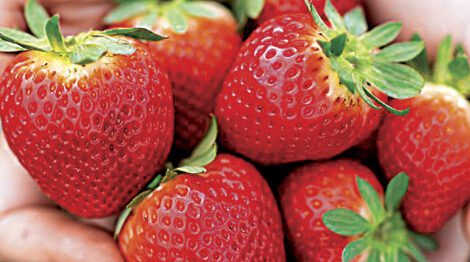
Strawberries are a favorite treat, with $2.2 billion in sales annually in the United States; Florida provides most of the nation's winter strawberry crop, worth more than $400 million annually. Improving the taste of strawberries has been a goal of growers for many years, and the genes that control flavor and aroma are closely connected.
University of Florida scientists have studied more than 100 chemicals that influence a strawberry's aroma, and by sequencing the approximately 100,000 genes in each strawberry, they have identified the genes of several dozen aromatic chemicals and the regulators that turn these genes “on” as the fruit ripens. The scientists are now developing tools such as DNA markers so that strawberries can be bred more efficiently for flavor.
Florida is the nation's leading producer of begonias, which are among the top five most popular plants found in gardens and landscapes. The two major factors that stress begonias are heat and humidity, and while growers can control these factors during production, the plants will not respond well to heat once outside the greenhouse and in the landscape. A joint grant from the USDA and the Florida Department of Agriculture and Consumer Services is helping UF scientists to find a begonia that can withstand the pressures of our changing climate. Identifying new begonia varieties that will respond better to heat and humidity will allow growers to use less energy for cooling, and less water and fungicides in production, and will minimize environmental impacts while maximizing profits.
More than 20 UF scientists across the state of Florida have been working on development regulators, which are genes that regulate plant growth and development. One of the genes that the scientists have discovered helps deliver DNA into a plant to stimulate growth, resulting in plants that can grow from the cellular level to adulthood more quickly and efficiently. Breeding programs will eventually use this technology to create desirable traits in plants and develop new cultivars, including new varieties of citrus, tomatoes, strawberries, blueberries, peanuts, sugarcane and ornamental plants.
You've undoubtedly heard lots about artificial intelligence (AI) recently, and Dr. Charlie Messina, a new UF/IFAS professor of Horticultural Sciences, is using AI to help plant breeders. This spring, Dr. Messina collaborated with plant breeders to develop a graduate level course titled "Survey of Breeding Tools and Methods." This course introduced advanced concepts in AI that can be used to transform technology in agriculture.
Dr. Messina will be teaching a modeling course this fall that will enable students to use AI to enhance their work with agricultural data. Through his efforts, Dr. Messina is educating the next generation of AI developers who will use this technology in conjunction with plant breeders to provide farmers with optimal crops.
These are just a few of the exciting projects currently underway to improve agriculture in our state, led by the scientists at the University of Florida. Ultimately their work will make agriculture more ecologically efficient and result in superior crops that bring additional revenues into our state economy. The University of Florida and its professors are helping to distinguish Florida as a leading agricultural innovator, and in turn they are also providing a great return on our tax dollars!
Cathy Dunn is a Lee County Master Gardener Volunteer and a member of the Garden Club of Cape Coral. Visit us at gardenclubofcapecoral.com.