

Trending
Eight years ago, when we moved here, I went to an orchid seminar but it seemed overwhelming. However, recently I have started to enjoy the Phalaenopsis orchid. I bought some at Publix and received some as gifts! I had a lot to learn!
Did you know that a Phalaenopsis is also known as the "moth orchid?" It is a genus of around 70 orchid species native to Southeast Asia, southern China and India. Now I understand why they make such great houseplants! Their flowers are long-lasting, they can last two to four months. Phalaenopsis orchids have short stems with elongated leaves, long coarse roots and beautiful flowers on a branching stem. Excitement, as I recently found a yellow flowering moth orchid with dark pink stripes (pictured above). The usual bloom colors are white, pink and purple.
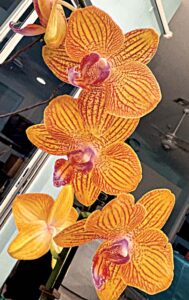
A Phalaenopsis orchid, also known as a moth orchid. ANN BLOCK
Don't throw your orchid out once it loses its flowers. I learned that a dehydrated orchid can be revived in a couple of months, while an orchid on the brink of death could take years to get back in good shape.
How can I make my orchid re-bloom? After an orchid's blooms fall off, you should trim the flower spike, adjust watering and light, and consider fertilizing and repotting. Specifically, you can either leave the flower spike intact, cut it back to a node or remove it entirely.
For a more detailed instruction:
Trim the flower spike:
If the spike is still green: You can leave it as is, as some orchids can rebloom from the same spike.
If the spike is turning brown: Cut it back to a node (a small bump on the stem) or all the way to the base of the plant. This encourages the orchid to focus its energy on new growth.
Water:
Don't reduce watering just because the blooms are gone. Allow the potting mix to dry out slightly between waterings to prevent root rot.
Provide indirect light:
Place your orchid in a location where it receives plenty of light but avoid direct sunlight, which can scorch the leaves.
Maintain humidity:
You can mist the plant but we have so much humidity, you may not have to do that.
Fertilize:
Once a month us a balanced orchid fertilizer to provide the plant with the nutrients it needs.
Repot if necessary:
If the orchid has outgrown its pot or the potting medium is decomposing, repot it into a new pot with fresh orchid potting mix.
My favorite way to make my Phalaenopsis orchids happy after they lose their flowers is to clean the roots of the orchid completely, cut off soft or brown roots and attach to my palms. I put them in a palm to provide shade and moisture. They are epiphytes which means that they grow on trees and palms but won't harm them. They prefer any palm or tropical hardwood tree with rough bark.
Right location:
Phalaenopsis orchids prefer shade and can be damaged by direct sunlight. Choose a location on the tree that offers protection from the afternoon sun, such as the north or east side. In Southwest Florida's humidity, the roots can usually retain enough moisture, but you might need to mist them daily, especially in the beginning. I usually don't bother, especially during rainy season.
Attach:
Use a any material that will eventually decompose, like cotton string.
Fertilize:
You can fertilize monthly with a specialized orchid fertilizer. Again, I haven't bothered with fertilization once attached to my palm and they are doing extremely well.
Tips:
Start with healthy plants: Choose a healthy Phalaenopsis orchid (moth orchid) with good roots.
Best options when considering putting your orchid in palms or trees, choose shady palms or Tropical hardwoods.
Be patient...it can take several months for the roots to attach and for the orchid to fully adapt to its new environment.
Happy gardening!
Ann Block is Past President of the Garden Club of Cape Coral. Visit our website. Like us on Facebook and Instagram.