
Island Coast High School club helps global communities
Trending
A group of students are "changing the world, one village at a time," at Island Coast High School after one Golden Apple finalist brought a program to the states, which she began while teaching overseas.
"I am proud to work with students who respect themselves and others, strive to improve their school community and serve as globally aware citizens who embrace other cultures. They are such a blessing in my life," Island Coast High School Global Ambassadors Service Club Advisor Francy Johnson said.
For Global Ambassadors Service Club President Ny'Keira Huffman, a senior, the club has helped in setting a path after graduation.
"Being a part of this club has opened my eyes and set my career goal on wanting to start my own nonprofit organization for unfortunate communities," Huffman said.
After Sept. 11, the Lee County teacher said she wanted a better understanding of Muslim culture and ideology, which started a program to help her students.
"I started a Global Friendship program between my students and students in Kuwait, so we could have a better understanding of our cultures," Johnson said. "They found that they had far more in common than differences. At the end of the project, the Kuwaiti girls invited me to visit their country. My trip there was very positive, and I promised the Kuwaiti students I would learn Arabic and come back to teach for a few years. After three semesters of Arabic, I took a leave of absence and left to teach in Kuwait for two years."
Johnson began volunteering in the community at an orphanage because it was important to her to learn as much as she could about the culture.
"Students often asked about my weekend and why I would go to workplaces for free, so I explained the concept of service and tied it into one of the pillars of Islam, Zakat. Soon, the students wanted to join me, so I formed the club as a service club. Each week the school provided a bus for us to do service," she said.
Soon the club had 40 members who spent their weekends sitting with cancer patients, cleaning beaches and walking animals at the local shelter. Johnson said in Kuwait many people did not like dogs, so she had the shelter put puppies in their hands.
"With their eyes still shut, it was hard to be afraid of them. Today, almost all those students have their own dogs, so the culture changed," she said.
Community service was the focus of the first group in Kuwait, which then grew into full-service learning.
Johnson taught at an all boys Muslim Military Academy where she had 25 boys in her club. The ambassadors worked with the local orphanage, headed a sports day at the primary school and brought the orphans to the academy to spend a day with a buddy. Johnson said out of respect for the orphans, none of the ambassadors wore their usual nametags that day.
"Next we took on a large service project, restoring an abandoned beach mosque in Al Thakira. Out of respect for the people and culture, I was fully covered as we worked on the restoration," she said. "The police were curious about what we were doing and soon began guarding the site for us. When we finished our work, we brought in Arabic rugs and a student climbed the turret, singing the call to prayer through the evening air. People on the beach stopped to see what was happening; and as the sun set, slowly over the coast, the boys led a prayer in the mosque for the first time in hundreds of years. The city was so impressed, they made it a national heritage site and did a full-scale renovation."
Johnson also taught in Russia at a U.S. Embassy School, which had students from 65 countries. She had a capped membership of 40 students and an interview process to get into the club, as they wanted to attract students with the greatest passion of truly making a difference.
For more than five years there was a wait list of 30 to 50 students hoping to join the club.
"The first year, the students voted to build a school in Africa and we began researching and raising funds. Each year, I took the students on a 10-days service trip to Africa where we worked in the villages, met with elders, and determined future projects based on the needs of the community and the sustainability of the projects. Students did the research: determining cost, getting approvals from village elders. Every summer I would spend six weeks in Africa checking on projects, getting updates and keeping the relationships going with the community," Johnson said.
The ambassadors raised more than a quarter of a million dollars for projects in Africa.
"It means that there are no limits to kindness and when you give students respect and opportunities, they can change the world. I am so proud to work with students who see beyond their school community and impact villages thousands of miles away. Ambassadors is not just a club, it's a family, and families are forever. All the students who have passed through this program still support each other and cheer for each other, no matter where they are in the world," Johnson said.
The group spent every Monday fundraising at lunch, held large fundraisers monthly on weekends, as well as a yearly Global Evening at the Four Seasons, which generated thousands of dollars to fund projects.
With the money raised, they transformed the village of Kamatanda Zambia by building a primary school, adult school, library, teacher housing and started a community garden. Johnson said the volunteer teachers had been orphans from the village.
"We paid for their teacher training, so they could become certified teachers," she said. "When the first group of primary students were ready to go on to a secondary school, we sponsored their education, so they could continue learning."
In addition, the ambassadors completed numerous projects in Pandamatenga, Botswana and Victoria Falls, Zimbabwe. Johnson said she and the students would visit the communities they helped, so the students could see what kind of impact they made.
"The high school Ambassadors soon formed an Ambassadors club for elementary students which they ran and mentored," she said. "The elementary students made 500 new mom kits to give to the village clinic so new moms had a blanket and supplies to take their babies home with."
Island Coast High School
Three years ago, Johnson brought the Global Ambassadors Service Club to Island Coast High School. Although there have been some setbacks, such as many students learning from home last year, the program is steadily growing, she said. For students to join the club they have to fill out a written application, as well as go through an interview process.
Johnson said applicants need to show passion and commitment to doing their best going forward, rather than having perfect attendance, grades, or behavior. She said if students do not attend weekly meetings, or participate consistently in fundraisers and service projects, they will be removed from the club.
Huffman got involved during junior year and it became the first club opportunity that provided community service hours, as well as allowing to engage with peers.
"I gained leadership skills with my role as president, which has allowed me to actively engage with service projects while overseeing them," Huffman said. "It has taught me how to collectively interact my peers with one another and allow for each of us to become involved with our community and global issues."
Ava DeAngelo, a sophomore, got involved at the end of her freshman year.
"I wanted to join the program because I love to volunteer and I was new to the school, so I wanted to be involved in a group where I could meet new people," she said. "I have gained new friends, memories, and a sense of joy knowing that I'm making a difference in the world, whether it might be small, or big, I'm still making a difference. Global Ambassadors has taught me that there are always people in the world in need and doing something to help them in any way is something we should strive to do as a group and as an individual."
DeAngelo said she definitely believes that Global Ambassadors has helped guide her in the route she wants to pursue after graduation.
"I 100 percent want to continue helping my community, as well as other communities and will continue to do so after graduation," she said.
The club's main focus is to support education in rural villages in Africa. The first village, Botswana, was chosen because U.S. Ambassador Michael McFaul said it was a relatively safe country that the embassy would allow students to visit.
"We did our research online and found a project with Building Botswana to build a primary school in Pandamatenga, Botswana. We were drawn by the goal that it would bring black students and white students together in a classroom for the first time. This was our most extensive project with huge setbacks and delays, eventually evolving into a preschool/community center based on the wishes of the elders and the need we witnessed in the community. Future projects evolved from our meetings and discussions with the villagers and elders," Johnson said.
The ambassadors have installed a well for the community, built a bread oven, established a community garden, as well as build a playground for the children. As they visited the region they met more people and created additional connections leading to larger opportunities to help.
The club found a partnership opportunity with the Wildtrack Safaris Eco Lodge, which allows Johnson to bring students overseas at a reasonable cost and collaborate on an awareness campaign. Some of those campaigns have included providing free AIDS tests with the health department, and an alcohol awareness campaign, which led to the community garden. The ambassadors also installed mosquito nets in huts, as malaria concerns were shared with the president of Botswana.
"To date, Ambassadors have installed over 500 mosquito nets in huts in Pandamatenga, protecting families from this deadly disease," Johnson said.
The students spend time determining costs and raising funds, making it a true service-learning project.
Fundraising Director Andrea Rivero, a senior student, said she joined this year after hearing about it from her culinary class last year.
"I feel there aren't too many clubs that help globally, so this was an amazing opportunity. Making a difference feels good," she said. "Global Ambassadors has helped me meet new people. It has helped me become a little bit more outspoken. Being a part of this program has educated me on what's going on in Africa and ways that we can help people there. It has taught me to be more aware of what's going on globally and the different cultures around the world."
At school the ambassadors have a kindness corner, a fixture in their cafeteria.
With a partnership with King Arthur Flour, which provided flour and materials, the club taught 500 students how to bake bread. She said each made two loaves, one to keep and one to share.
"The beauty of this project is that students learned to bake bread that they could do at home for their families and were able to experience the positive rewards of giving to others," Johnson said.
Huffman said the Bakers for Good sale has been a favorite project.
"I was able to help out with the basketball team make biscuits and gravy with the flour we were donated and created a team bonding experience with them," Huffman said.
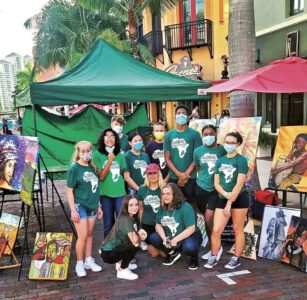
This year the ambassadors are supporting global artists who have been impacted by COVID-19. Johnson said they ship art here from Botswana, Zambia, Zimbabwe and Iraq to sell at the Downtown Fort Myers Art Walk.
"The students offer an African Animal coloring station, so every child can take home their own masterpiece. The artists use the funds raised to pay for their children's education and keep their families fed," Johnson said.
DeAngelo said it is nice to get out there and sell art that has impacted the artists by helping them get money to obtain the important things they need in their life.
Art Walls has been Rivero's favorite project.
"I've been to all the ones we've had this year. It feels amazing to help people in need, especially knowing their stories. Selling art can be challenging, but it's worth it. I hope that we can one day sell all the art we receive," she said.
The ambassadors also help support Cristone, a young man in Zambia, through bottled water sales and car washes at Advanced Auto Parts. Although the young man had high grades and passed exams, he could not continue school because of lack of money, as his mother left due to no food to eat.
"He was hunting for rats and snakes when the headteacher contacted us. Now he is in school and dreams of being a pilot," Johnson said.
Last summer she visited Cristone in Zambia and brought back videos for her students to meet the boy they have been helping.