
Trending
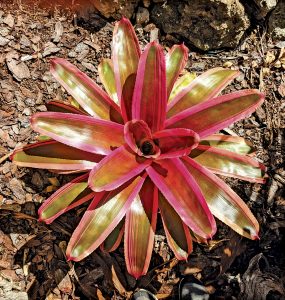
When I saw my first bromeliad, I thought, "What a perfectly arranged plant, shaped like a flower." Yes, the leaves spiral out of the center of the plant and arrange themselves to circle the middle in a "rosette." This is especially true for the neos, short for Neoregelia, one type of bromeliad. As they grow up, the center becomes more colorful and tiny flowers appear for several weeks. But the main attraction are the center leaves that "blush" with color as the plant comes into bloom. They have been bred to flush out in a variety of bright hues from purple to peach, with red as the most common.
Most neos like some shade and look beautiful under a tree, where not much else will grow. They will also easily grow in a small pot for the size of the plant and happily bloom on the patio.
There are other bromeliads in the family called Aechmea, which bloom differently. They have a stem coming out of the middle and hold the flower above the plant. These flowers take a wide variety of interesting forms. Although the flowers last just a day, the bracts that hold them are colorful structures that sometimes last for months. Many of these will grow in full sun, such as the bright orange leaf blanchetianna, which you see growing in many Cape Coral yards. It reaches an impressive 3 to 5 feet. Their bloom spike divides into orange-red branches which last for months.
Another beautiful Aechmea is called silver vase with gray and cream striped leaves and a round pink ball with blue flowers. This pink ball lasts several months. It is happy as a houseplant or outside in shade.
As in the photo of this neo called "Yin," water collects in the center. Leaves and other debris land in the center, decompose and provide nutrients for the plant. While the roots do provide some nutrients, mostly they anchor the plant to the ground. Most bromeliads are epiphytic, meaning they can grow on a tree branch, palm trunk or rock, and get what they need by the water held in their center cup. One example is Aechmea orlandiana, which has attractive stripes.
Besides having seeds, bromeliads multiply by putting out a side shoot, called a "pup." By planting an orlandiana at the base of a tree, each pup will attach to the tree a little higher on the trunk. After a few years, the pups will appear to be climbing the tree. This will not hurt the tree. What a fun look!
Billbergia is another family member with flowers that are held above the plant. These plants are often shaped like an urn, long and tall. Flaming torch is one variety whose bloom is a red ball with blue flowers, lasting a week. I have seen it blooming away in sunny front yards, but they appreciate a bit of shade to keep rich green leaves.
Air plants are also bromeliads, in the family Tillandsia. These are totally epiphytic. They just have a few roots that stick to a piece of driftwood or a branch of your tree. You will often see our native air plants in live oak trees. Storms may knock them out of the tree to the ground. I pick these up and place in my own trees or on a wooden plaque with fishing line or a tie wrap.
By the way, pineapples are bromeliads, too!
Care of bromeliads is so easy! They prefer to grow in soil that drains freely. Regular potting soil with one third sand or perlite added works well. Planting directly in our sandy soil works fine, too. Water with rain water or tap water, keeping water in the cups. Well water usually contains salt and will slowly kill a bromeliad. If you wish to fertilize, dilute it to half strength or you may burn the leaves.
Bromeliads add a uniquely tropical feel to your home and landscape. There are more families and varieties than I can describe here. They are a fascinating group of plants to explore.
To see more bromeliads, see the new additions to the Edison/Ford Gardens, where they are growing in the ground and on the trees. Most local nurseries have bromeliads, too.
For more information, visit the University of Florida website: edis.ifas.ufl.edu. And the Bromeliad Society International: bsi.org.
Sherie Bleiler is a member of the Garden Club of Cape Coral and chair of the Butterfly Garden at the SW Library. Visit us at gardenclubofcapecoral.com. Like us on our Facebook Page.