
Garden Club: The cloudless sulphur butterfly
Trending
My butterfly garden contains host plants for a variety of butterflies, including Gulf fritillaries, monarchs, zebra longwings and cloudless sulphurs. The cloudless sulphurs always seem to catch my eye as their bright yellow forms soar and then flit throughout the garden, and I see them often as they are one of the most common butterfly species found in Florida.
These butterflies are observed in more northern parts of Florida during the fall southward migration, but they linger in our area year-round similar to their monarch butterfly cousins. I've often chuckled when I read the explanation that some butterflies are like your grandparents - they came south to Florida and decided not to go back north!
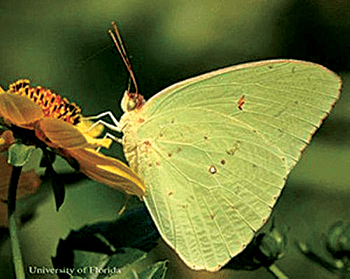
The cloudless sulphur butterfly takes its scientific name, Phoebis sennae, from Phoebe, who was the sun god Apollo's sister in Greek and Roman mythology, and Senna, the genus that includes most of the cloudless sulphur's host plants. The butterfly's common name is due to its bright yellow color which resembles the color of sulphur, and the lack of any dark spots or cloud-like marking on its wings, making their wings appear relatively clear. Cloudless sulphurs are widespread in the southern United States but have been found as far west as Colorado and as far north as Canada. The species is also found throughout South America and the West Indies.
Adult butterflies are small, with wing spans ranging from 1.9 to 2.6 inches, and are usually bright yellow, although some females can be pale yellow or almost white during the summer months. One of the most interesting attributes of this species is the relatively long tongue that the butterflies possess, which allows them to reach the nectar in tubular-shaped flowers that other butterflies cannot access. Cloudless sulphurs are attracted to red flowers, especially scarlet creeper, red morning glory and scarlet sage. The female butterflies lay eggs singly on the host plant, and larvae feed on the foliage, buds and flowers of the host plant. Most larvae are green with lateral yellow lines, blue patches and bands of tiny blue spots with short black hairs, however, if the larvae feed on the yellow flowers rather than the leaves of the host plant, they will be yellow with black bands. I have observed yellow larvae on my senna plants when they are in bloom while green larvae are present on the lower, unflowering portions of the plant!
The pupa of the cloudless sulphur butterfly looks almost like a leaf. The larva attaches to a twig and the pupa hangs vertically; the colors range from green to pink and can be challenging to find on the host plant. To date, I have not been successful in identifying a pupa in my garden!
There are many native and non-native plants that serve as host plants for cloudless sulphur butterflies. The native host plants include Florida Keys sensitive pea; Maryland wild sensitive plant; Narrowpod sensitive pea; Partridge Pea; Privet wild sensitive plant; Sensitive pea; Chapman's wild sensitive plant; and Coffeeweed. Non-native or "introduced" host plants include Africa senna; Candlestick Plant; Glossy Shower and Septicweed. Please be aware that Christmas Senna, Senna pendula var. glabrata is considered to be invasive by the University of Florida and should not be planted in South Florida. Sometimes this plant is sold under the incorrect name of Senna bicapsularis; before buying any senna variety masked as "Christmas Senna" as a host plant for cloudless sulphurs, please check the botanical identity carefully.
I have planted the Privet Senna, or Senna ligustrina, in my butterfly garden and it is a wonderful variety for attracting cloudless sulphurs. The plant grows fairly rapidly but can be pruned often to keep it from taking over. The long bean-like seed pods will also produce many "volunteer" plants; I endeavor to cut these pods off before they can dispense their seeds as I have limited space. I also try not to prune my Senna when it is flowering because the sulphurs seem to view the blooms as caviar! Try one of these easy and attractive plants in your garden and watch for the joyful yellow butterflies flitting through the air to visit your landscape.
Cathy Dunn is a Lee County Master Gardener Volunteer, Garden Club of Cape Coral Member and president of the James E. Hendry Hibiscus Chapter. Visit www.gardenclubofcapecoral.com. Like us on our Facebook page!