
Garden Club of Cape Coral | Grace your landscape with groundcover
Trending
A neighbor of mine had a side yard that sloped toward the street. I watched him each week as he laboriously hand-mowed that area of grass. Soon, the turf became sparse and he hired a landscaper to do the mowing. A simple solution could have saved the neighbor time, effort and money: ground cover. Ground covers are low-lying ornamentals that spread quickly and usually grow from 1-24 inches in height. They have a horizontal spread and are often used to cover sections of ground where grass does not grow well or where slopes make it difficult to mow.
In choosing a type of ground cover, remember to keep these questions in mind: Is the location in full sun or a shady area? Do you want to attract pollinators, fill in some bare spots or replace a grassy section? Low-lying perennial plants are often used for ground cover, but creeping shrubs, ornamental grasses or self-seeding annuals can also be used.
Once you have created your plan, you can begin to prepare your planting site. First remove unwanted vegetation. Then till the soil to loosen it. A quicker method is to lay cardboard over the vegetation and then to add soil and organic matter, such as compost or manure.
Estimate the number of plants you will need based on recommended spacing. Dig planting holes at least twice as wide as the root ball and just as deep. Gently loosen the roots as you remove the plant from the pot and place each in its hole. Fill the remaining hole with soil and water the soil around the plant thoroughly. Frequent watering and a 2-inch layer of mulch to control weeds is necessary until the plant is established.
Many diverse ground covers are suitable for hardiness zone 10a, which includes most of Lee and Collier counties. Let's first explore ground covers that tolerate open, sunny areas.
Kitten's tail (Acalphia reptans var.) Is a diminutive, creeping relative of the chenille plant. It has bright green leaves and bristly red, tail-like inflorescences for most of the year. Baby sunrose (Aptenia cordifolia) has dark green foliage and red, aster-like flowers which bloom nearly year-round. Perennial peanut (Arachis glabata), a favorite among gardeners, blooms through the summer with cheery yellow flowers. When planting perennial peanut, space plants 12-18 inches apart. They will fill in the area a few months after planting.
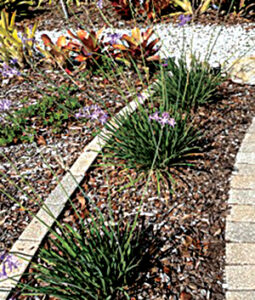
One of my favorites, society garlic (Tubaghia violacea), produces delicate, star-shaped lavender flowers which reach up on stalks to about 2 feet tall. The leaves smell of garlic when you brush up against it. Bulbine (Bulbine frutescens) adds a bright and cheerful appearance in spring to summer with bright yellow or orange flowers atop 2-foot-tall stalks. Powder puff mimosa (Mimosa strigillosa), also known as sunshine mimosa, has green feather-like leaves which fold up when touched and pink, ball-shaped flowers resembling powder puffs. It blooms from spring through fall and serves as a host plant for butterfly larvae. Powderpuff mimosa is not evergreen, so be prepared for the leaves to disappear during the winter months.
Because most turf has difficulty growing in shady conditions, groundcovers offer an attractive alternative. Dymondia (Dymondia margaretae) is a showy evergreen which will form a dense silvery-green mat over time and will provide small, yellow daisy-like flowers in the summer. A variety of hostas (Hosta plantagenia) do well in shady areas. Hosta leaves come in a diversity of sizes, shapes and forms with multiple shades of blue, green, gold, white and red. This plant is extremely hardy and provides little maintenance. Perennial peanut will persist in partial shade, but its thickness is reduced.
Use care when selecting a ground cover. Some are listed as invasive and not recommended for planting, such as bugleweed (Ajuga reptans). Visit UF/IFAS's Assessment of Non-native Plants website for more information.
Ground cover is dynamic and versatile. I believe that ground cover can complete a landscape by filling in barren areas with leafy patterns and colorful blooms. It also chokes out weeds, which allows us time to sit and enjoy our gardens, keeping cool in shady areas from the hot summer sun.
Carole Kerns is a Master Gardener Volunteer with UF/IFAS Lee County Extension. She also volunteers at the Berne Davis Botanical Garden where several of these ground covers can be viewed.