
While planning for the 2023 hurricane season make sure your home is covered
Trending
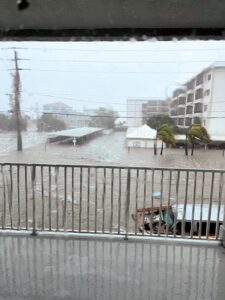
As rebuilding continues to take place from Hurricane Ian, homeowners should start planning for the 2023 hurricane season by making sure their homes are covered.
There are quite a few things to take into consideration when equipping your home with insurance, one of which is flood insurance.
Harbour Insurance Independent Agent Jessica Plate said although June 1 starts the hurricane season, May 1 is the soft opening and homeowners should be ready with the best policies in place to protect their property.
There were many who had premiums that remained the same for many years until the beginning of 2021 when the National Flood Insurance Program revamped its program and launched 2.0. With the high increases, Plate said it caused folks to make adjustments to their policy they did not understand.
Lee County Insurance owner John Gardner said first off everyone is in a flood zone, whether at high or low risk. On average, about 27 percent of all flood coverages are paid in low risk zones.
“Flood is actually the most, out of all the claims paid. Flood is the No. 1 occurrence nationally in claims. It happens,” Gardner said. “Make sure you understand what is covered and what is not covered. You have to read the policy to figure that out.”
Plate said homeowners should also be aware of the elevation certificate that is available to them, which measures how high the house is built up in reference to the base flood elevation in that area. She said there is a subsidized rate on a flood insurance policy if the elevation certificate states the home was built higher than what FEMA states.
“Those run about $200 to get done. They don’t expire. You can pass it along with the home, if you sell it,” Plate said. “It’s very good information to know how high the house is built up.”
There are a few ways to purchase flood insurance, with more than 95 percent falling under the NIFP. Gardner said many call this the FEMA Flood Program, as it is federally backed with insurance companies administering it and handling the sales.
“That is not a FEMA grant, or loan. It is an insurance product backed by FEMA,” Gardner said.
Another option is private flood insurance, which is relatively new. Private flood insurance is required to cover everything the federal flood program covers, with better options.
For example, NIFP provides $250,000 for maximum coverage for a single family home and $500,000 for maximum coverage for commercial.
“The private flood program might be $10 million. I just did one this week for $1.5 million,” Gardner said.
In addition, a private plan also provides an option to buy replacement cost coverage for your contents, which is not provided with the federal program. Private also provides additional living expenses, so someone can pay for a hotel if they are not able to stay in their home.
“It may not be cost feasible for private. They can set their own rates,” Gardner said of insurance companies. “Typically (there are) better options available and sometimes worth paying the extra money.”
Flood insurance has a 30-day wait period, unless a loan is closing when it can be done on the date of closing.
A noteworthy thing to remember when selecting your homeowners insurance policy is the only way to save money is by reducing coverage to a home.
“What do you not want covered, or what are you willing to take a risk on yourself to reduce your premium,” Gardner said. “Always ask the question, how does this compare to my current coverage? What am I not covered for if you get the cheaper price?”
Plate said the typical hurricane deductible is 2 percent of the dwelling value, or the replacement cost estimator that determines what the rebuild of the house is going to be. For example, she said the house is worth $500,000, the hurricane deductible is usually 2 percent of that, on average.
“Cost of construction has increased, cost of labor, especially after the hurricane. Homes are being determined to cost more to be built. Dwelling is higher and deductible is higher for a hurricane. Everybody got higher increases . . . increase dwelling value on policy and increase premium,” Plate said.
As far as homeowners insurance, Gardner said there have been tremendous changes to hurricane deductibles. Some policies have wind, which is typically 2 percent of what the home is insured for.
“If you got wind protection – shutters, panels – and you are getting a discount for them, make sure they are up,” he said, as there are some provisions in a policy that will remove the credit if they are not deployed.
The insurance company can either make you pay back all the money from the credit, or deny the claim because the homeowner failed to protect their home.
Plate said another change with insurance targets roofs, specifically the age of shingled roofs. Homeowners were told that there is a 25- to 30-year life expectancy on roofs, however they were getting penalized by the insurance company for shingled roofs aging more than 15 years old.
“They were not canceling people, or non renewing them because of the age of the roof, they were imposing an actual cash valuation of the roof covering, rather than covering at replacement cost,” Plate said, adding that meant they were taking the actual cash value of the 15-plus year old roof, rather than the roof itself. “Each year, the roof loses value.”
For instance, a 16 year old roof may have a value of $5,500, but the hurricane deductible is $10,000.
“At the end of the day they don’t have coverage for that roof,” Plate said, which she said explains why some roofs may still have tarps after Hurricane Ian.
There are many things that are not covered under homeowners insurance, specifically for hurricanes. All others are considered Other Peril Deductible (AOP), such as fire, theft and lightning.
For example, pool cages and screen enclosures are typically not covered, unless the policy holder adds a specific amount of coverage and pays a certain premium.
An option, as some policies include this measure, is the manage repair programs. Gardner said some offer it as optional, while a handful is mandatory. He said the company, or preferred vendor, comes out and fixes the damage for you.
“You don’t want to rip out damage before the adjuster is there, or hire a contractor under a manage repair program because they are not going to pay that guy,” Gardner said.
Another important thing to remember is to report a claim as soon as possible after a hurricane, or event takes place.
“You don’t want to wait six months to say I have roof damage because you have had six months of exposure to all the other wind, or rain events that have caused further damage,” Gardner said.
If a homeowner waits too long they can put them in the position of denial because they did not file in a timely manner.
In terms of writing new policies, homeowners insurance carriers are shutting down quicker and quicker when a hurricane nears. If there is a watch, or warning issued, you are done, Gardner said.
“If you wait until then, it is already too late,” he said.
As far as cancellations in homeowners insurance, there are far more companies that fail, go bankrupt or liquidated than leaving the state of Florida. In the last two years, Gardner said 10 have failed with the most recent being UPC.
“They actually sold their books of business in other states. They sold those books of business trying to prop up Florida. Premiums are higher in Florida and so is the exposure. They ultimately still failed because Ian hit at that point and put (them) into liquidation,” Gardner said.